


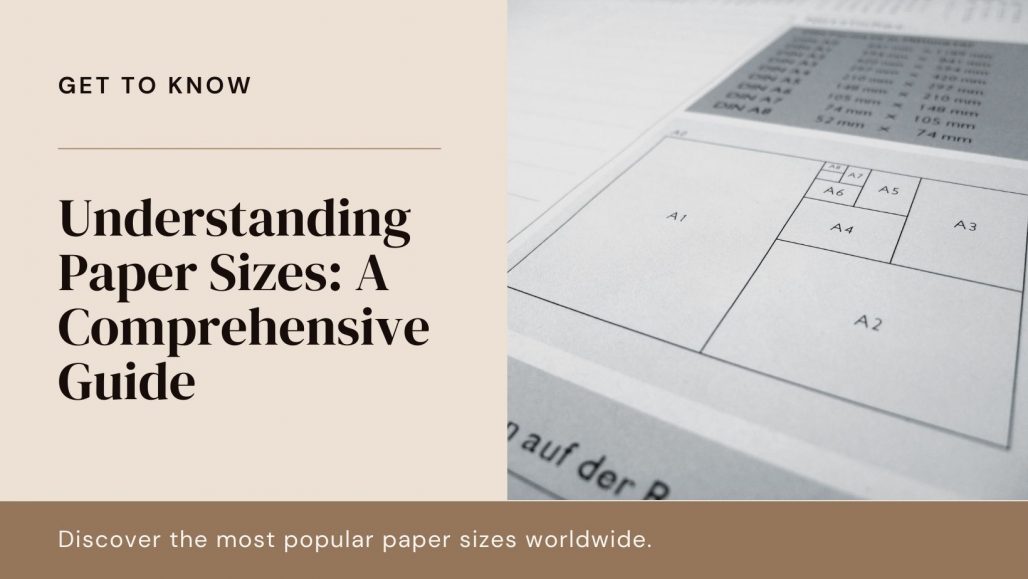
We bet your office has plenty of A4 sheets in the printers and at least one A5 notebook full of notes on your desk. If you’re somewhat familiar with paper formats, you’ll have realised that we’re referring to printer paper and notepads.
The list of paper formats is very long and, let’s admit it, not very fascinating. It’s always about numbers! Here, we want to present it in a more practical and, we hope, more useful format. We’ll talk about the sizes of different paper formats, yes, but we’ll also focus on their most common uses: posters, brochures, cards, books, business cards, and many other projects.
ISO 216 Paper Formats, a Brief Mention of the Standard
Let’s start with the boring part: the ISO 216 standard, which classifies different paper formats by sheet size, creating an international standard. This way, all European countries (the US and Canada use the Letter format) can communicate in the same language, at least concerning paper formats.
According to the standard, formats are created by subdividing a starting sheet without any waste material. In the A series, the most common, the starting sheet is A0, which is folded and cut to create all other formats. How is it folded? Well, we’re not going to explain that here because it would be too dull. After all, what you want to know is which paper format is best suited for your project, right?
Here’s a summary table of the formats in the A series
The A series, the “fundamental” one, has 10 subgroups: from A0, the largest, to A10, the smallest. Then, there are the B and C series, the “complementary” ones, which also follow a numbering system. What does “fundamental” and “complementary” mean? It means a letter written on an A4 sheet can fit into a C4 envelope, and the C4 envelope can fit into a B4 envelope. This is because the C4 sheet is slightly wider than an A4, and the B4 is slightly wider than the C4.
In the B series, formats range from B0 (1,000 × 1,414 mm) to B10 (31 × 44 mm), if you’re in the publishing world. In fact, B5 (176 × 250 mm) is a good size for books. B0 (1,000 × 1,414 mm), B1 (707 × 1,000 mm), and B2 (500 × 707 mm), given their large proportions, are suitable for printing posters and banners or for office presentations. As for the C series, which ranges from C0 (917 × 1297 mm) to C10 (28 × 40 mm), you should know that it is the “complementary” series par excellence, as it is mainly used for making postal or letter envelopes.
Before Printing: Understanding Paper Weight
Paper weight is a fundamental property to consider before printing, as it affects both the appearance and feel of the final product. Paper weight, measured in grams per square metre (g/m²), determines the quality and durability of the paper. Knowing the appropriate weight is essential for:
- Selecting the right paper for printing: Different projects require different types of paper. For example, business cards need thicker paper for strength and durability, while brochures can be lighter.
- Achieving desired printing results: A higher weight offers less transparency, improving print quality, especially for double-sided printing.
- Adjusting the perception of the product: The weight can influence how the value of the printed product is perceived. Higher-weight promotional or marketing materials are often seen as higher quality.
Available Paper Weights and Their Technical Descriptions and Characteristics
Paper weight varies widely, offering options for all types of applications:
- Light paper (less than 150 g/m²): Ideal for brochures and magazines. It offers good print quality with a light feel and easy handling.
- Medium paper (150-250 g/m²): Commonly used for flyers and posters. It balances durability and cost without being too heavy.
- Heavy paper (more than 250 g/m²): Perfect for business cards, invitations, and book covers. This type of paper is significantly thicker, making it more durable and giving it a higher quality feel.
- Specialised paper: Includes options like photographic paper, watercolour paper, and other types designed for specific purposes, which can have unique weights and textures.
A Series: Formats, Sizes, and Uses
Below, we present each format’s corresponding size and possible uses. We say “possible” because there are no rules linking a project to a specific sheet size. What does exist are conventions. When you think of a card or postcard, for example, you likely visualise an A6 format. However, nothing stops you from breaking the mould. If you want, you can make a postcard of Lisbon shaped like a sardine. However, in this case, besides wasting paper, you’ll have to dive into a “sea” of printing quotes to “fish” for the best one, as we’re talking about a custom format and… sardines!
Format A0. Dimensions: 841 × 1,189 mm
It is the largest format of all. Its considerable size means it is exclusively used in copy shops and graphic design centres. The same goes for A1 and A2. It is mainly used for technical design, which requires rather large sheets to comfortably respect the project’s proportions without having to work with a magnifying glass. It can be used for posters, although the most common formats in this field are 700 × 1,000 mm and 1,000 × 1,400 mm.
Format A1. Dimensions: 594 × 841 mm
The large A1 sheet is also used for technical design, as well as for maps, posters, and other advertising materials requiring large formats.
Format A2. Dimensions: 420 × 594 mm
The uses of the A2 format can vary: design, photo printing, posters, diagrams, large wall calendars, or sheets for a blackboard.
Format A3. Dimensions: 297 × 420 mm
Along with A4, it is undoubtedly one of the most common sizes. For this reason, most office printers are designed for A3 sheets, as well as A4. What is it used for? It is used for printing drawings, graphs, posters, photographs, magazines, sheet music, posters, and diplomas. In advertising graphic design, it can also be used for brochures (folded into 6). In fact, its wide surface can represent a convention centre map or a very detailed diagram.
Format A4. Dimensions: 210 × 297 mm
Everyone, even the least knowledgeable, knows that A4 is the classic printer sheet used for standard documents, whether letters or forms. It is the format of notebooks used in schools, children’s books, and encyclopedias (which require more space for illustrations), magazines, and brochures. In fact, the classic brochure is an A4 folded into three.
Format A5. Dimensions: 148 × 210 mm
The A5 format is also widely used. We started this article by saying that you probably have an A5 notebook on your desk. A5 is the perfect format for notepads: less bulky than an A4, convenient for taking notes, and not taking up much space in your backpack. For the same reason, A5 can also work well for printing books, as well as magazines and brochures.
Format A6. Dimensions: 105 × 148 mm
This format is also very well known, especially if you have the nostalgic habit of sending postcards from places you’ve visited or accompanying a gift with a greeting card or a thank-you card. Postcards and cards are in A6 format. Additionally, the A6 sheet size is perfect for printing brochures, pocket diaries, and pocketbooks.
Format A7. Dimensions: 74 × 105 mm
Given its smaller size, A7 can be used to create, for example, a pocket calendar with the schedules of a sports centre or a school, as well as brochures or greeting cards.
Format A8. Dimensions: 52 × 74 mm
To get an idea of the A8 format, just look at your wallet:
business cards and loyalty cards are usually in a similar, slightly larger format (85 × 55 mm). So, nothing prevents you from using this standard format for business cards, greeting cards, stickers, or labels.
Here is a summary table with the measurements of the various A series formats expressed in millimetres, centimetres, inches, and pixels to make choosing easier:
| Format | Dimensions in millimetres (H x W) | Dimensions in centimetres (H x W) | Dimensions in inches (H x W) | Dimensions in pixels (H x W) |
|---|---|---|---|---|
| A0 | 1189 x 841 mm | 118.9 x 84.1 cm | 46.8 x 33.1 inches | High resolution – 14,043 x 9,933 pixels Low resolution – 3,370 x 2,384 pixels |
| A1 | 841 x 594 mm | 84.1 x 59.4 cm | 33.1 x 23.4 inches | HR – 9,933 x 7,016 pixels LR – 2,384 x 1,684 pixels |
| A2 | 594 x 420 mm | 59.4 x 42 cm | 23.4 x 16.5 inches | HR – 7,016 x 4,961 pixels LR – 1,648 x 1,191 pixels |
| A3 | 420 x 297 mm | 42 x 29.7 cm | 16.5 x 11.7 inches | HR – 4,961 x 3,508 pixels LR – 1,191 x 842 pixels |
| A4 | 297 x 210 mm | 29.7 x 21 cm | 11.7 x 8.3 inches | HR – 3,508 x 2,480 pixels LR – 842 x 595 pixels |
| A5 | 210 x 148 mm | 21 x 14.8 cm | 8.3 x 5.8 inches | HR – 2,480 x 1,748 pixels LR – 595 x 420 pixels |
| A6 | 148 x 105 mm | 14.8 x 10.5 cm | 5.8 x 4.1 inches | HR – 1,748 x 1,240 pixels LR – 420 x 298 pixels |
| A7 | 105 x 74 mm | 10.5 x 7.4 cm | 4.1 x 2.9 inches | HR – 1,240 x 874 pixels LR – 298 x 210 pixels |
| A8 | 74 x 52 mm | 7.4 x 5.2 cm | 2.9 x 2.0 inches | HR – 874 x 614 pixels LR – 210 x 147 pixels |
| A9 | 52 x 37 mm | 5.2 x 3.7 cm | 2.0 x 1.5 inches | HR – 614 x 437 pixels LR – 147 x 105 pixels |
| A10 | 37 x 26 mm | 3.7 x 2.6 cm | 1.5 x 1.0 inches | HR – 437 x 307 pixels LR – 105 x 74 pixels |
B Series: Formats, Sizes, and Uses
With much less common usage, B series paper formats are typically used in professional print shops for printing books, brochures, passports, etc. What’s the main difference from the A series? With the same numbering, a B format sheet will be slightly larger than the same A format sheet.
Here is a summary table with the measurements in millimetres, centimetres, inches, and pixels of the different B series formats:
| Format | Dimensions in millimetres (W x H) | Dimensions in centimetres (W x H) | Dimensions in inches (W x H) | Dimensions in pixels (W x H) |
|---|---|---|---|---|
| B0 | 1000 x 1414 mm | 100 x 141.4 cm | 39.4 x 55.7 inches | HR – 11,811 x 16,701 pixels LR – 2,835 x 4,008 pixels |
| B1 | 707 x 1000 mm | 70.7 x 100.0 cm | 27.8 x 39.4 inches | HR – 8,350 x 11,811 pixels LR – 2,004 x 2,835 pixels |
| B2 | 500 x 707 mm | 50.0 x 70.7 cm | 19.7 x 27.8 inches | HR – 5,906 x 8,350 pixels LR – 1,417 x 2,004 pixels |
| B3 | 353 x 500 mm | 35.3 x 50.0 cm | 13.9 x 19.7 inches | HR – 4,169 x 5,906 pixels LR – 1,001 x 1,417 pixels |
| B4 | 250 x 353 mm | 25.0 x 35.3 cm | 9.8 x 13.9 inches | HR – 2,953 x 4,169 pixels LR – 709 x 1,001 pixels |
| B5 | 176 x 250 mm | 17.6 x 25.0 cm | 6.9 x 9.8 inches | HR – 2,079 x 2,953 pixels LR – 499 x 709 pixels |
| B6 | 125 x 176 mm | 12.5 x 17.6 cm | 4.9 x 6.9 inches | HR – 1,476 x 2,079 pixels LR – 354 x 499 pixels |
| B7 | 88 x 125 mm | 8.8 x 12.5 cm | 3.5 x 4.9 inches | HR – 1,
039 x 1,476 pixels |
| B8 | 62 x 88 mm | 6.2 x 8.8 cm | 2.4 x 3.5 inches | HR – 732 x 1,039 pixels LR – 176 x 249 pixels |
| B9 | 44 x 62 mm | 4.4 x 6.2 cm | 1.7 x 2.4 inches | HR – 520 x 732 pixels LR – 125 x 176 pixels |
| B10 | 31 x 44 mm | 3.1 x 4.4 cm | 1.2 x 1.7 inches | HR – 366 x 520 pixels LR – 88 x 125 pixels |
C Series: Formats, Sizes, and Uses
The formats in the C series are used more frequently than you might think. In fact, they are used to make envelopes for letters. If we think about it, a C4 envelope, for example, is made to fit an A4 sheet precisely. Likewise, a C5 sheet fits perfectly in a B5 envelope. Therefore, the C series is known for being a “complementary” series, designed to adapt to the different formats of the other series.
Here is a summary table with the measurements in millimetres, centimetres, and inches of the various C series formats:
| Format | Dimensions in millimetres (W x H) | Dimensions in centimetres (W x H) | Dimensions in inches (W x H) |
|---|---|---|---|
| C0 | 917 x 1297 mm | 91.7 x 129.7 cm | 36.1 x 51.5 inches |
| C1 | 648 x 917 mm | 64.8 x 91.7 cm | 25.5 x 36.1 inches |
| C2 | 458 x 648 mm | 45.8 x 64.8 cm | 18.0 x 25.5 inches |
| C3 | 324 x 458 mm | 32.4 x 45.8 cm | 12.8 x 18.0 inches |
| C4 | 229 x 324 mm | 22.9 x 32.4 cm | 9.0 x 12.8 inches |
| C5 | 162 x 229 mm | 16.2 x 22.9 cm | 6.4 x 9.0 inches |
| C6 | 114 x 162 mm | 11.4 x 16.2 cm | 4.5 x 6.4 inches |
| C7 | 81 x 114 mm | 8.1 x 11.4 cm | 3.2 x 4.5 inches |
| C8 | 57 x 81 mm | 5.7 x 8.1 cm | 2.2 x 3.2 inches |
| C9 | 40 x 57 mm | 4.0 x 5.7 cm | 1.6 x 2.2 inches |
| C10 | 28 x 40 mm | 2.8 x 4.0 cm | 1.1 x 1.6 inches |
As we’ve mentioned before, what we’ve stated in this article are just general guidelines. Feel free to break them!
Looking for a reliable printing company?
Get an instant quote