



Table of Contents
Anyone who runs a business needs key figures to measure success and make well-founded decisions. This article explains the break-even point and how to calculate this figure.
1. What is the break-even point?
One of the key performance indicators of a business is the break-even point. A company must make a profit to continue existing and growing. The entrepreneurial profit (another word for it: the “surplus”) results from the difference between the turnover and the costs. If costs are higher than sales, the profit is negative. Then there is a loss.
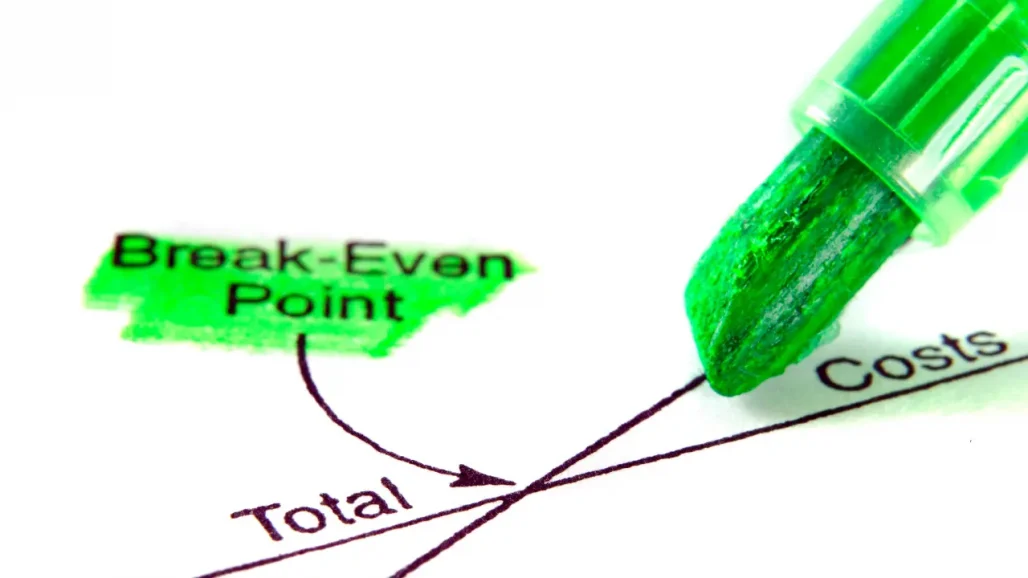
The break-even point is the point at which sales exactly equal costs. This is where the break-even point is located. Another name for the break-even point is the “break-even point”. This variable fulfils an information function and a control function.
Information function: By determining the break-even point, you can clarify the following questions: What quantity do I have to sell for sales to equal costs? What minimum sales volume must I achieve so the company is not loss-making?
Control function: The break-even point also serves as a basis for decision-making. Because if you are unable to sell the required quantity or achieve the minimum sales, then appropriate countermeasures are indicated. Otherwise, the company is threatened with insolvency. If you know the break-even point, you can determine at an early stage how much a drop in sales can be absorbed. Countermeasures include, for example, expanding marketing or sales activities, cost-cutting programs or removing loss-making products from the range.
2. Single-product and multi-product approach
Determining the break-even point may be relevant in the following cases. For example, The owner or manager of a company that has just been founded wants to determine the break-even point for all products (multi-product consideration). An existing company wants to expand its product range and calculate the break-even point for the new product (one-product consideration). In the single-product approach, reporting the break-even point as several units are expected. In contrast, in the multi-product approach, you will report total sales.
3. Sales and costs
It is possible to calculate the break-even point if the sales and the total costs are known. Turnover is the product of quantity and price. Other terms for turnover are “revenue” or “sales revenue”. Total costs are the sum of variable costs and fixed costs. While variable costs depend on the quantity produced (for example, material costs), fixed costs take effect regardless of quantity (for example, rent and property tax). You get the variable unit costs if you divide the total variable costs by the quantity produced. These form the short-term price floor for a product. This is because if you offer the good at a lower price, you will make a loss on each unit sold. This is something no company can sustain in the long run.
4. Contribution margin
If you subtract the variable unit costs from the price per unit, you get the contribution margin per unit:
Contribution margin per unit = price per unit – variable unit cost.
If you want to determine the contribution margin of a product for the company, you should multiply the quantity produced on both sides of this formula. This then results in the following:
Contribution Margin = Sales – Variable Costs
This contribution margin tells you how much the product covers the company’s fixed costs. With the help of these quantities, you can determine the break-even point.
5. Break-even point calculation
The break-even point is reached when:
Sales = Total costs
Or converted:
Sales – Total costs = 0
According to the above formulas, you get the following:
(price x quantity produced) – ((variable unit costs x quantity produced) + fixed costs) = 0.
6. Break even point formula
You can now solve this equation towards the quantity produced. Then you get:
Quantity produced = fixed costs / (price – variable unit costs).
You can replace the denominator of this fraction with the contribution margin per unit according to the above formula. This results in the formula:
Break-even point = fixed costs/contribution margin per unit.
By applying this formula, you will know the minimum quantity of the product you need to sell to reach the break-even point.
7. Break-even point example
A book company wants to sell new books. The fixed costs for production are £6000 per month. The variable cost per piece is £2. The price for a book should be £5. The company wants to determine the break-even point.
The contribution margin per a book is calculated as follows:
£5 – £2 = £3
Now you can apply the formula for the break-even point:
£6000 / £3 per piece = 2000 pieces.
So the company must sell at least 2000 books to reach the break-even point. From the 2001st book, the book company makes a profit by producing work shoes.
8. Break-even point analysis
If you want to perform a break-even point analysis for your company, you should collect the following variables as accurately as possible:
- fixed costs
- variable costs
- price
- turnover
For illustration purposes, it is recommended to use an Excel template. By entering the formula for the break-even point, you automatically get the result and can see how the change of individual variables affects the break-even point.
9. Conclusion
The break-even point refers to the point at which sales are exactly equal to costs. From this point on, the company makes a profit. The costs refer either to a single product or to the entire company. This tells you what quantity you need to sell to cover costs. If there is a danger that your company will fall into the loss zone, you will recognize this early with the help of this variable.
Looking for a reliable printing company?
Get an instant quote